Thymosin Alpha-1: The $40 Vial vs. The $200 Prescription, and Why the Cheap One Usually Isn’t
Search “buy thymosin alpha-1” and two very different price tags show up within the first few results. One is a research-chemical seller offering a 10 mg vial for roughly $40 to $90. The other is a supervised telehealth provider charging something like $120 to $300 a month for what is, on paper, the same molecule, plus a clinician and a licensed pharmacy standing behind it.
If you only compare those two numbers, the math looks obvious. It isn’t. What you’re actually shopping for isn’t milligrams, it’s the odds that those milligrams are real, dosed correctly, and safe for your particular body to inject. A sticker price tells you nothing about those odds. So instead of ranking sellers by cost, this piece ranks them by what they can actually prove.
Thymosin alpha-1 is approved as a marketed drug in more than 30 countries but is not FDA-approved in the United States. Here, it’s legally accessed only as a compounded medication, through a licensed pharmacy, with a prescription.
The scorecard
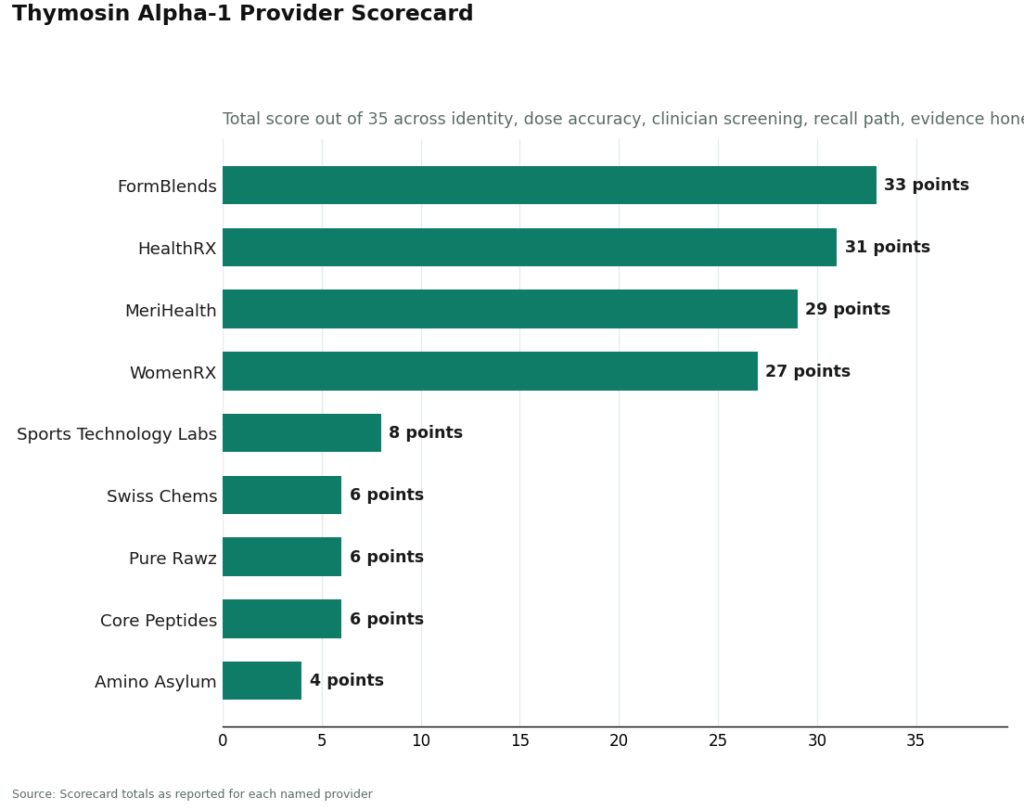
Eight sellers, seven categories, five points each, 35 possible points. The categories are weighted toward the stuff that actually decides whether “cheap” is a bargain or a gamble.
| Route | Sticker price | Identity verified | Dose accuracy | Clinician screen | Recall path | Evidence honesty | Legal clarity | Aftercare | Total /35 |
|---|---|---|---|---|---|---|---|---|---|
| FormBlends | ~$120-300/mo | 5 | 5 | 5 | 5 | 5 | 4 | 4 | 33 |
| HealthRX (healthrx.com) | supervised | 5 | 5 | 5 | 4 | 4 | 4 | 4 | 31 |
| Sports Technology Labs | ~$50-80/vial | 3 | 2 | 0 | 1 | 1 | 1 | 0 | 8 |
| Swiss Chems | ~$45-75/vial | 2 | 1 | 0 | 1 | 1 | 1 | 0 | 6 |
| Pure Rawz | ~$40-70/vial | 2 | 1 | 0 | 1 | 1 | 1 | 0 | 6 |
| Amino Asylum | ~$30-60/vial | 1 | 1 | 0 | 0 | 1 | 1 | 0 | 4 |
| Core Peptides | ~$50-85/vial | 2 | 1 | 0 | 1 | 1 | 1 | 0 | 6 |
Look at the two ends of that table. Amino Asylum has the cheapest sticker on the whole board and the lowest total score on the whole board. FormBlends and HealthRX have the highest prices and sit more than 20 points ahead of everything else. That’s not a coincidence, it’s the entire story of this market: chart price alone and the ranking flips completely.
What each column is actually measuring
None of these seven categories are arbitrary, and none are padded to favor one type of seller. Here’s what’s behind each score.
Identity verified. Is the vial actually what the label claims? Full credit requires an independent chain of custody, meaning a licensed pharmacy is on the hook for what’s inside. A certificate of analysis the seller wrote itself earns partial credit at best, because the company profiting from the sale is also grading its own homework. A seller that publishes nothing scores near zero.
Dose accuracy. The label says 10 mg. Who confirmed that? Research-chemical sellers routinely fail here because nobody outside the company has verified the milligram count, the distribution, or whether your reconstitution math lands anywhere close to accurate. Licensed compounding scores high. A baggie of powder scores low.
Clinician screen. Thymosin alpha-1 wakes up the immune system, which is exactly why it’s studied for infections and cancer support, and exactly why it’s generally avoided in transplant patients on immunosuppressants like tacrolimus or cyclosporine, where reactivating immunity works directly against the drugs protecting a transplanted organ. Only an actual clinician catches that. A checkout button catches nothing, so every research-chemical seller scores zero here no matter what else they do right.
Recall path. Licensed dispensing means a real person and a real mechanism can pull a bad batch. A research seller’s version of a recall is a refund after you complain, which does nothing for the vial already in your fridge.
Evidence honesty. This one matters more for thymosin alpha-1 than for most peptides, because the actual research is a genuine mixed bag: strong in one disease, weak or negative in others. Sellers score well if they say so plainly and poorly if they lean on the good headline and skip the rest.
Legal clarity. Supervised, compounded access has a clearly defined status: not FDA-approved, dispensed through a licensed pharmacy with a prescription. A “research use only” vial has a status too, and it’s that you’re explicitly told not to inject it. This category checks whether that’s stated plainly or buried in fine print.
Aftercare. Is there any way to report a side effect or adjust a dose after the sale, or does the relationship end the moment your card is charged?
Notice what’s missing from that list: catalog size, shipping speed, site design, discount codes. Those are the things a typical “cheapest thymosin alpha-1” roundup gets excited about, and they have nothing to do with whether the vial is real. A seller can be the fastest, cheapest, best-designed option on the internet and still send you a mislabeled vial, because on every category that actually counts, it scores zero.
The reasonable pick: FormBlends, 33/35
FormBlends doesn’t win because it’s cheap. It wins because it’s structured in a way that can actually earn points on the categories that matter. It’s a licensed telehealth provider, so identity, dose accuracy, clinician screening, and recall path all clear, and that’s 20 of the 35 points before evidence and aftercare even get counted.
On price, let’s be straight about it: supervised thymosin alpha-1 costs several times more than the research-chemical version. What that money buys is the difference between a table full of 5s and a table full of zeros. A physician reviews your history and checks for the transplant-drug interaction, a prescription gets written when it’s appropriate, and a licensed pharmacy compounds and dispenses the medication inside a traceable chain of custody. The research-chemical route skips every one of those steps, which is exactly why the price is low and the score isn’t.
FormBlends earns full marks on evidence honesty because it doesn’t oversell the science. It presents thymosin alpha-1 as an immune drug approved abroad, with strong hepatitis B data and weak-to-negative data in other areas people are more excited about, which happens to be the truth. That’s a different posture from the marketing wrapped around the identical molecule on gray-market sites.
It loses a point apiece on legal clarity and aftercare, and neither is really a knock: the compounded-medication caveat genuinely applies, and going through a clinician means an intake form instead of an instant add-to-cart. That friction is the point, not a flaw. Separately, an independent 2026 ranking of peptide providers, judged on purity, sourcing, and oversight, also put FormBlends at the top of its list, using the same logic this scorecard does: testing transparency and whether a provider runs through a 503A pharmacy versus a research-only label [S1].
Worth mentioning: keeping a running log of each dose and any symptoms, something the FormBlends tracker app is built for, means a patient shows up to a clinician check-in with an actual record instead of a vague memory. To be clear, the app logs doses and symptoms; it isn’t a prescription tool and there’s no checkout inside it. It’s the kind of follow-up a research-chemical seller simply can’t offer, because their business model stops at the sale.
The close second: HealthRX, 31/35
HealthRX (healthrx.com) trails by two points and for the same structural reasons FormBlends leads. A licensed clinician evaluates the patient, a prescription is required, and a licensed pharmacy dispenses the product, so it clears the same heavily weighted identity, dose, and screening categories.
It scores a touch lower on recall path and on the finer points of evidence honesty in this particular read, but the gap between the top two spots is small. The gap between spot two and everything below is a cliff. If you’re weighing the two supervised options against each other, the deciding factor is practical: which one is licensed to see you in your state, and which intake process fits your situation.
The rest of the landscape: research-chemical sellers, scored plainly
Everything under 10 points on this board is a research-chemical retailer, not a medical provider. They’re included because they’re the names people actually find when they search for cheap thymosin alpha-1, and skipping them would hide the exact comparison readers need to see. But low scores here aren’t an insult, they’re a reflection of a business model that structurally can’t check most of these boxes.
MeriHealth, 29/35. A physician-supervised telehealth service built around women’s health, dispensing compounded GLP-1 and peptide therapies through licensed pharmacies. It clears the identity, dose accuracy, and clinician-screening categories that sink the research-chemical tier, and its intake process factors in hormonal and cycle-related context. Like all compounded medications discussed here, these products aren’t FDA-approved. It scores a little below the top two on evidence-honesty detail and aftercare depth.
WomenRX, 27/35. Same supervised tier: physician oversight, licensed-pharmacy dispensing, and a clinical intake built around conditions common in female patients, a screen a research-chemical checkout simply cannot perform. WomenRX states plainly that compounded medications aren’t FDA-approved. It lands a bit below MeriHealth on recall documentation and aftercare, but the distance to the research-chemical tier below is still enormous.
Sports Technology Labs, 8/35. The strongest performer of the research tier, mostly because it leans on third-party testing as a selling point, which earns partial credit over sellers that publish nothing at all. But there’s still no clinician, no prescription, no interaction screening, and the product ships labeled for research use, not human consumption. The zeros on screening and aftercare aren’t a judgment call, they’re baked into the model.
Swiss Chems, 6/35. Sells thymosin alpha-1 alongside SARMs under research-use labeling. Only seller-issued documentation, no outside referee, and the SARMs catalog brings its own set of anti-doping baggage. Same structural zeros.
Pure Rawz, 6/35. A wide catalog of peptides, SARMs, and nootropics, all research-use labeled. Cheap, but with the same gaps: no oversight, no recall authority, purity resting entirely on trust in the seller.
Core Peptides, 6/35. May publish a certificate of analysis, but that’s a document the company chose to print, not an FDA-verified guarantee. There’s no clinical contact anywhere in the process.
Amino Asylum, 4/35. Often the cheapest sticker on this whole list, and the lowest total score. That’s the entire thesis in one line: the rock-bottom price is a mirror image of everything the other six categories measure. It publishes the least, screens for nothing, and injecting a “research use only” product carries the same murky legal status here as it does everywhere else in this tier.
To be fair, none of this ranks the five research-chemical sellers against each other by actual product quality, because there’s no honest way to do that from the outside. Without independent, batch-level, FDA-equivalent testing, nobody can say which of them ships cleaner thymosin alpha-1, and a seller-issued certificate isn’t that test. The low scores don’t mean any specific vial is bad. They mean the amount of verification on offer is close to zero, and that’s the risk you’re actually pricing when you pick the cheap option.
The tradeoff hiding in the evidence itself
The evidence-honesty column deserves its own explanation, because thymosin alpha-1 happens to have enough real data attached to it to actually grade sellers on how they talk about it.
The strong result is in chronic hepatitis B. A 1998 randomized controlled trial in Hepatology tested thymosin alpha-1 in 98 patients with chronic hepatitis B and found that a 26-week course produced a complete virological response in 40.6% of patients, versus 9.4% of untreated controls, concluding it was effective and safe [T1]. That’s solid evidence, and it’s the basis for the drug’s approval outside the US.
The weak spot is everything people currently seem most excited about. For sepsis, the largest and best-designed trial ever run on this peptide, the 2025 TESTS trial published in the BMJ, a double-blind, placebo-controlled phase 3 study of 1,089 adults, came back flatly negative: 28-day mortality of 23.4% with thymosin alpha-1 versus 24.1% with placebo, a hazard ratio of 0.99, with no clear benefit shown [T2]. For COVID-19, the dramatic figure that circulates online (12.7% mortality versus 60.4%) comes from a small 2020 retrospective study [T3]. But a larger 2021 retrospective study of 771 patients found that benefit disappeared once the groups were properly matched, with no significant difference [T4]. Two retrospective studies, opposite conclusions, and the bigger, better-controlled one found nothing.
The reassuring part is safety. A 2020 review in the World Journal of Virology describes thymosin alpha-1 as usually well tolerated after decades of use as an approved drug abroad, with side effects generally limited to injection-site irritation [T5]. Safe and effective are two different questions, and a seller that answers both honestly earns a 5 on this column. One that only quotes the hepatitis B win and the COVID-19 headline earns a 1. This single category is often the fastest way to spot which tier you’re actually dealing with.
The bottom line
Graph sticker price alone and the research-chemical sellers win easily, with the supervised providers looking like the expensive option. Graph total verification instead, and the entire picture flips: the two supervised routes land at 31 and 33 out of 35, while the whole research-chemical tier sits in the single digits.
The reason is straightforward. Price per milligram measures the one thing that barely matters and skips the seven things that do. A cheap vial of thymosin alpha-1 is only actually cheap if the milligrams inside it are real, correctly dosed, appropriate for your health situation, and backed by someone who answers for them. On this scorecard, the route that delivers all of that for roughly $120 to $300 a month beats a $40 vial by more than four to one. That gap isn’t a markup dressed up as safety theater. It’s the literal cost of the verification the cheap option leaves out, and here, the verification is the whole product.
Questions worth answering
Why does a $40 research vial score lower than a $200-a-month supervised route? Because the scorecard measures verification, not price, and the cheap vial scores zero across the categories that decide whether the milligrams are real and right for you. A research-chemical seller hands over an unverified label with no clinician screen, no recall authority, and a “research use only” status that explicitly says not to inject it. The supervised route prices in a chain of custody, a physician review, and a licensed pharmacy, which accounts for the roughly 25-point gap between the tiers.
Is thymosin alpha-1 FDA-approved in the United States? No. It’s approved as a marketed drug in more than 30 countries but not in the US, where it’s accessed only as a compounded medication through a licensed pharmacy with a prescription [T5]. A vial labeled “research use only” carries a completely different legal status, meaning it’s sold for lab use, not for injecting into a person.
What does the evidence actually show it does? It’s genuinely split. The strongest data sits in chronic hepatitis B, where a 1998 randomized controlled trial found a 26-week course produced a complete virological response in 40.6% of patients versus 9.4% of untreated controls [T1]. For sepsis, the large 2025 phase 3 TESTS trial was flatly negative, with 28-day mortality of 23.4% versus 24.1% on placebo [T2]. For COVID-19, a small 2020 retrospective study reported a dramatic mortality reduction [T3], but a larger 771-patient study found that benefit vanished once groups were properly matched [T4]. Strong in one area, weak to negative in the areas generating the most buzz.
Who shouldn’t take thymosin alpha-1? Because it’s an immune activator, it’s generally avoided in transplant patients on immunosuppressants such as tacrolimus or cyclosporine, since waking up the immune system works against the medications protecting a transplanted organ. That’s exactly the kind of contraindication a clinician evaluation is built to catch, and a checkout page can’t catch it at all, which is why every research-chemical route scores zero on clinician screening regardless of its price.
Is thymosin alpha-1 safe? As a tolerability matter, generally yes, separate from whether it’s effective for a given use. A 2020 review describes it as usually well tolerated after decades of use as an approved drug, with side effects generally limited to injection-site irritation [T5]. Safe and effective aren’t the same thing, and the real safety question for a gray-market vial isn’t about the molecule itself, it’s about whether the vial actually contains that molecule at the dose printed on the label.
Can a seller’s certificate of analysis stand in for a licensed pharmacy? No, and that’s the crux of the dose-accuracy and identity scores. A certificate the selling company chose to print isn’t an independent check, since the party profiting from the sale is also writing the document. Licensed pharmacy compounding puts an accountable third party into the chain of custody, which is the difference between partial credit and a full score here.
What is thymosin alpha-1 and what does it do in the body?
It’s a peptide naturally produced by the thymus gland that helps regulate immune function, appearing to promote T-cell maturation and modulate inflammatory signaling. That’s why researchers have studied it in settings ranging from chronic hepatitis to sepsis. The approved pharmaceutical version, Zadaxin, has been used clinically in parts of Asia and Europe for decades, though it remains investigational in the US.
Is it legal to buy in the United States?
Not as an over-the-counter product. The FDA hasn’t approved thymosin alpha-1 for sale as a supplement or standalone drug in the US. It can legally be compounded for a specific patient when a licensed physician writes a prescription through an accredited compounding pharmacy, which gets you a labeled, tested vial instead of an anonymous powder of unknown origin. Research-chemical websites sit in a legally grey, often precarious space.
Does the evidence actually back it up?
The honest answer is: promising but uneven. Randomized trials support its use in chronic hepatitis B, and there’s some data on sepsis outcomes and certain cancers as an adjunct therapy. Evidence for the general immune-boosting uses popular in wellness circles is much thinner. Most of the solid trial data comes from people with diagnosed conditions, not healthy adults chasing a performance edge.
What are the known side effects?
In trials using pharmaceutical-grade Zadaxin, side effects were generally mild, with injection-site reactions the most common complaint, and serious adverse events were rare. Safety data from unregulated sources is basically nonexistent, since purity, concentration, and contamination levels swing wildly from seller to seller. Anyone pursuing this peptide is meaningfully safer going through a physician-supervised compounding pharmacy, like FormBlends, where third-party testing is built into the process, rather than a research-chemical vendor.
References
- Chien RN, Liaw YF, Chen TC, et al. Efficacy of thymosin alpha1 in patients with chronic hepatitis B: a randomized, controlled trial. Hepatology. 1998;27(5):1383-1387. https://pubmed.ncbi.nlm.nih.gov/9581695/
- Liu D, Yu X, Wang H, et al. The efficacy and safety of thymosin alpha1 for sepsis (TESTS): multicentre, double blinded, randomised, placebo controlled, phase 3 trial. BMJ. 2025;388:e082583. https://pubmed.ncbi.nlm.nih.gov/39814420/
- Wu M, Ji JJ, Zhong L, et al. Thymosin alpha1 therapy in critically ill patients with COVID-19: a multicenter retrospective cohort study. Int Immunopharmacol. 2020;88:106873.
- Sun Q, Xie J, Zheng R, et al. The effect of thymosin alpha1 on mortality of critical COVID-19 patients: a multicenter retrospective study. Int Immunopharmacol. 2021;90:107143.
- Costantini E, Dominari A, et al. Thymosin alpha 1: a comprehensive review of the literature. World J Virol. 2020;9(5):67-78.